.png)
.jpg)
Real progress in sustainable transport doesn't happen in isolation. True value is unlocked when best-of-breed digital systems collaborate to turn raw, complex data into actionable operational cost savings for transporters.
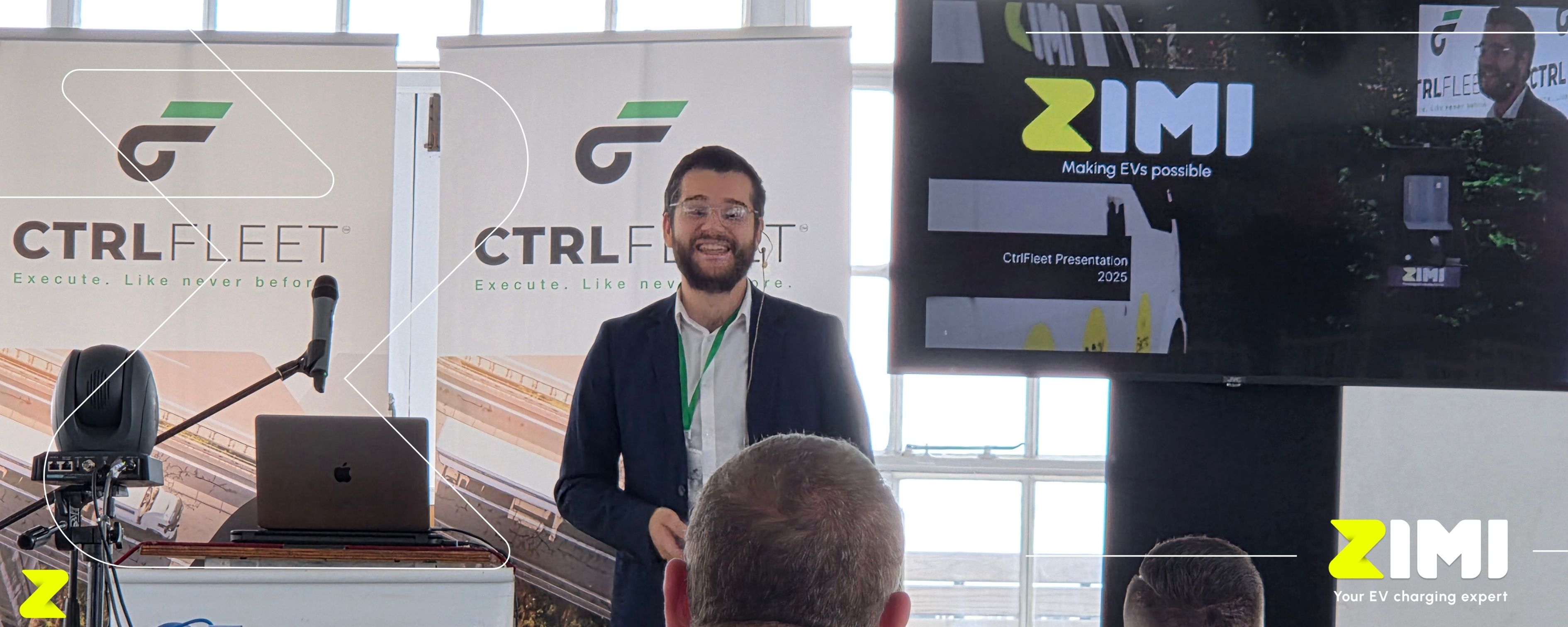
This theme of collaborative innovation was the focus of the recent Digital Dynamics: The Network Effect event, co-hosted by Control Fleet and the Transport Forum in Cape Town. Bringing together over a hundred in-person logistics operators, enterprise operations directors, and hundreds more regional transport leaders online, the hybrid summit explored how the integration of distinct software systems creates a geometric multiplier effect for fleet efficiency.
Taking the stage as a headline keynote speaker, Zimi co-founder and CEO Michael Maas delivered a masterclass on a crucial industry hurdle: how to successfully weave commercial electric vehicle (EV) ecosystems into modern, data-driven fleet management environments.
Stepping up to the podium, Michael Maas opened his address by acknowledging the rich history of localized tech innovation before introducing the next inevitable shift in logistics engineering.
"Seeing all of this innovation that's all locally built... just congratulations to everybody that's been building digital businesses focusing on the transport and fleet sector and really doing an amazing job," Maas began. "I'm adding one more acronym to your list: EV, electric vehicles."
Maas immediately focused his address on the core economic and regulatory realities driving the urgent shift toward commercial fleet electrification across Southern Africa:
"One of the biggest things that you're going to start facing now, if you haven't already, is carbon compliance. There's a lot of carbon pressure coming especially if you're working with European entities, if you have customer or stakeholder demand, if you have governance structures that are really pushing for the E in ESG to be reduced. You're going to be starting to face these pressures and you're going to start getting these types of requests from your customer contracts to say you have to give us a zero-carbon solution."
"But we all run businesses. One of the most important things to look after is your bottom line. And if you're looking at things like fuel, obviously it's driving a significant part of your operational expenditure. We really started Zimi to think about how can we build this end-to-end solution that you as a fleet operator can use to reach this ESG goal but then also drive down costs, which is really the big opportunity when using electric vehicles in your fleets."
For the corporate asset managers, procurement directors, and chief financial officers in the room, Maas highlighted the exact operational savings Zimi is unlocking for early adopters on South African roads:
"Looking at electric vehicles, one of the main drivers of cost savings really is the fuel savings. If you're making the switch from petrol or diesel to electric, you're saving up to 80% when charging on the grid and up to 90% when you're leveraging your existing solar assets. That really feeds the model of your TCO savings. And we're seeing with customers running routes of 150 km plus driving up to 30% total cost of ownership (TCO) savings. Think about that number, right? 30% savings. That's money that you could be using for new initiatives. It's money that you could be using to compete better in the market."
Recognizing that entering the EV space brings perceived technological and battery lifespan anxieties for conservative logistics operations, Maas detailed how Zimi eliminates those barriers through flexible, asset-light lease frameworks:
"A significant consideration when deploying these vehicles is really thinking about the risk that you want to be taking. Of course, electric vehicles do have risks if you think of something like the battery or the battery life, there's not always a guaranteed buyback, although some of the OEMs are providing it. So, you really want to think of ways that you can open up that cash flow by things like fully managed leases or rental options. And that's a great thing about electric vehicles is they really work well when you're starting with these trial periods and seeing how they're performing before you scale this up."
Maas broke down the four foundational pillars that Zimi packages together into a single platform to make commercial electrification completely frictionless for first- and third-party logistics firms, field services, and corporate delivery fleets:
The Vehicles: Sourcing commercially tested models. "We specifically only work with OEMs where we know that we're going to get and guarantee a cost saving for you on those vehicles," Maas noted, pointing to the active rollout of panel vans (BYD, Mercedes-Benz, DFSK, Foton) and heavy trucks ranging from 1-tonners up to multi-ton rigids and truck tractors.
Charging Infrastructure: Deploying ultra-fast DC equipment directly at client depots.
Energy Management: Bypassing traditional grid restraints. "We help actually optimize some of the solar solutions that you've put in place," Maas explained. "We've typically worked with customers where they have seen some overinvestment in solar. They're actually producing too much solar and they want to drive up that utilization. Electric vehicles are a perfect way in which to capture that energy that's otherwise just going to waste."
Digitization via the Network Effect: Seamlessly integrating EV data into existing fleet networks. "This is not replacing your transport management system," Maas emphasized. "It's enhancing the way that you use it while deploying electric vehicles."
Addressing the common concern of where fleet drivers can safely charge on extended distribution loops, Maas noted that while South Africa’s public charging network is growing, it presents unique commercial hurdles:
"There's about 250 public chargers in South Africa. Not all of these chargers are accessible to fleet vehicles. Mainly one of the biggest problems is height restrictions and length restrictions. So again, something by getting the data via your Control Fleet system to see exactly where you can charge and which charging stations are available are going to be critical for you in terms of planning your routes and planning your daily deliveries."
Maas concluded his keynote with a pragmatic guide on the ideal operational use cases for immediate deployment: "I don't think this is a good fit for any fleet. I don't think, for example, line-haul is there yet. But if you're doing urban routes and you're doing milk-run style deliveries, then it's definitely a great solution."
By anchoring our e-mobility ecosystem on open, interoperable technical standards and collaborative software integrations, Zimi’s keynote at Digital Dynamics proved that moving from diesel to digital is no longer a distant concept, it is a proven, high-yielding fuel hedge available to South African transport operators today.
.jpg)

